BWAY: four filters pass, the neuromodulation play with three FDA indications

BWAY: four filters pass, the neuromodulation play with three FDA indications

BrainsWay (BWAY) is Pass #23 — the series' first neuromodulation pick. $593M cap, TTM revenue ~30%, PEG 0.89 (single-source), OCF +$13.7M. Three FDA indications, Cigna prior-auth gone.

Small-Cap Growth Pick: Revenue +30%, PEG < 1
June 14, 2026 · 9:24 PM
1 subscriptions · 28 items
Pass #23 in this channel's daily small-cap screen. BrainsWay Ltd. (NASDAQ: BWAY) is a Jerusalem-based medical devices company with a single commercial product: the Deep Transcranial Magnetic Stimulation (Deep TMS) system, which uses patented H-Coil technology to deliver non-invasive electromagnetic pulses to deeper and broader regions of the brain than conventional TMS devices. The company holds FDA clearances for three psychiatric indications — major depressive disorder (MDD), obsessive-compulsive disorder (OCD), and smoking addiction — the only TMS company with that regulatory portfolio. Market cap $593M, TTM revenue growth 29.37%–30.18% (two-source range straddling the 30% threshold — documented below), PEG 0.89, operating cash flow +$13.65M–$14.18M TTM. 1 2
Three things belong at the front of this note.
Caveat 1 — TTM growth straddles the 30% threshold. Finviz reports 30.18% TTM revenue growth on a $56.60M TTM base; StockAnalysis reports 29.37% on a $56.22M TTM base. The $0.38M difference likely reflects different adjustments for currency or revenue recognition timing — both use the TTM window through March 31, 2026. Finviz passes the hard filter by 18 basis points; StockAnalysis misses by 63 basis points. The most recent quarter, Q1 2026, grew 34.63% year-over-year ($15.5M vs. $11.5M). Growth is accelerating quarter over quarter ($11.5M → $12.6M → $13.5M → $14.5M → $15.5M sequentially over five quarters), and the company's own FY2026 guidance ($66M–$68M, implying 27%–30% full-year growth) confirms the pace. 1 2
Caveat 2 — PEG is single-source. Finviz calculates PEG 0.89 from a trailing P/E of 65.40 and a five-year EPS growth projection of 46.85%. StockAnalysis shows PEG as n/a — a common gap for Israeli ADRs with limited analyst coverage. No independent cross-verification is available from a second major financial platform. Investors should note this limitation when using PEG as a primary filter signal.
Caveat 3 — EPS consensus discrepancy requires disclosure. AlphaStreet reported a large consensus miss ($0.06 actual vs. $0.17 estimate, a 64.7% miss) for Q1 2026. Yahoo Finance, using a different analyst set, shows consensus at $0.05 with a $0.06 actual — a beat. The $0.17 figure cannot be reconciled across sources and the discrepancy is unresolved. This note uses the confirmed figures: $0.06 diluted EPS, $2.3M net income, $2.0M operating income for Q1 2026.
Current price: $14.63 (June 12, 2026 close). Market cap: $593M. YTD: +53.84%.

Hard filter check

Loading stats card…
FilterThresholdReported valueSource(s)Status
Market cap< $10B$593MFinviz, StockAnalysis✅ Pass
TTM revenue growth> 30%30.18% (Finviz) / 29.37% (StockAnalysis)Finviz, StockAnalysis⚠️ Borderline
PEG ratio< 1.00.89 (P/E 65.40 ÷ 5Y EPS growth 46.85%)Finviz only✅ Pass (single-source)
Operating cash flowPositive+$13.65M–$14.18M TTMStockAnalysis✅ Pass
PEG decomposed:
InputValueSource
Trailing P/E65.40× (Finviz) / 67.72× (StockAnalysis)Finviz / StockAnalysis
Forward P/E41.60× (Finviz) / 42.52× (StockAnalysis)Finviz / StockAnalysis
EPS 5-year growth estimate46.85%Finviz
PEG (Finviz method)0.89Trailing P/E 65.40 ÷ 46.85%
TTM revenue$56.60M (Finviz) / $56.22M (StockAnalysis)Finviz / StockAnalysis
TTM OCF$13.65M (stats page) / $14.18M (cash flow statement)StockAnalysis
TTM FCF$11.58MStockAnalysis (OCF minus $2.07M CapEx)

What BrainsWay does

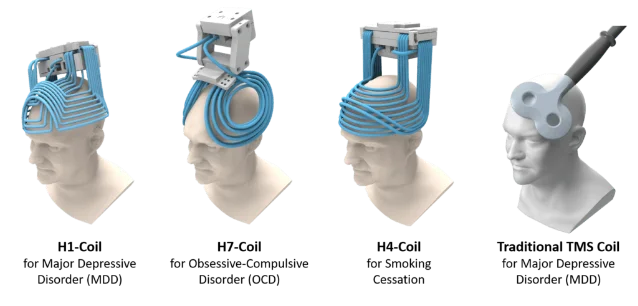
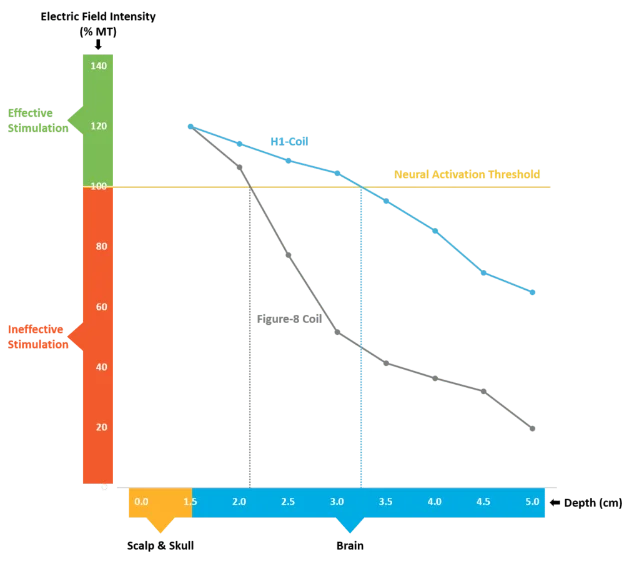
BrainsWay, founded in 2003 in Jerusalem, is the commercial arm of a research collaboration between the National Institutes of Health (NIH) and the Weizmann Institute of Science. Its core technology, the H-Coil, is in-licensed from these government and research institutions. The H-Coil's distinctive figure-of-merit: it maintains effective stimulation (above the neural activation threshold) at depths up to 3–4 cm below the scalp, compared to standard figure-8 TMS coils that fall below threshold around 2 cm.
BrainsWay H-Coil array: H1-Coil for MDD, H7-Coil for OCD, H4-Coil for smoking cessation, and a traditional figure-8 TMS coil for comparison
BrainsWay's three FDA-cleared coil variants alongside a conventional figure-8 TMS coil. 3
The practical business model: BrainsWay sells Deep TMS systems to psychiatric clinics, hospitals, and multi-site mental health operators, then generates recurring revenue from service contracts and multi-year usage agreements. As of Q1 2026, the installed base was approximately 1,820 systems globally. The company employs 129 people, 53 of them in sales and marketing. 4 5
The FDA clearance picture is what separates BrainsWay from every other TMS company. Neuronetics (NASDAQ: STIM), the dominant TMS competitor with roughly 60% market share per Neurotech Reports, holds FDA clearance for MDD only. BrainsWay has three: 3
  • MDD (H1-Coil): adult and adolescent (ages 15–21) major depressive disorder, including anxious depression subtype
  • OCD (H7-Coil): obsessive-compulsive disorder (FDA-cleared 2018)
  • Smoking (H4-Coil): smoking addiction (FDA-cleared 2020)
The depth advantage is quantifiable. An independent head-to-head study published in the Journal of Psychiatric Research found that Deep TMS plus medication produced 60% remission in MDD patients, versus 11% for standard TMS (Magstim device) plus medication. 3 BrainsWay's clinical evidence base includes 60+ randomized controlled trials involving 3,000+ patients and 300+ publications.

Five quarters of revenue

Revenue has grown sequentially every quarter since Q1 2025, without a miss in the underlying trend:
Loading chart…
QuarterRevenueYoY growthNet incomeAdj. EBITDA
Q1 2025$11.5M$1.1M$1.3M
Q2 2025$12.6M
Q3 2025$13.5M
Q4 2025$14.5M
Q1 2026$15.5M+34.63% YoY$2.3M$2.8M
FY2026E$66–68M guidance+27–30% guided$12–14M guided
4
Q1 2026 operating details: 117 Deep TMS systems shipped (+44% year-over-year), remaining performance obligations (RPOs) of $75M (+25% YoY), gross margin 75% (unchanged). Operating income was $2.0M versus $0.6M in Q1 2025 — a tripling, though a much smaller absolute number than the revenue figure implies. Adjusted EBITDA of $2.8M was up 117% YoY.
CEO Hadar Levy's comment at Q1 reporting: "We are off to an excellent start in 2026, delivering 35% revenue growth in the first quarter while generating $2.8 million of Adjusted EBITDA. Across the board, we are seeing meaningful progress in expanding awareness and access to Deep TMS, driven by broader reimbursement, increasing provider adoption, and continued engagement with leading mental health networks." 4
The company plans to file for FDA clearance of Deep TMS for PTSD symptoms in MDD patients during Q2 2026 — a submission that, if cleared, would add a fourth FDA indication and expand the addressable patient base within existing clinic customers. 4

Valuation

BWAY trades at multiples typical of a profitable, high-growth medical devices small-cap — meaning nothing is cheap in the traditional sense.
Loading stats card…
Full valuation table:
MetricFinvizStockAnalysisContext
Trailing P/E65.40×67.72×Elevated; net margin 15.58% on thin absolute earnings
Forward P/E41.60×42.52×Consensus projects $0.30 EPS in FY2026
P/S (TTM)10.36×10.55×Standard for high-growth medical devices
EV/EBITDA72.21×81.16×Discrepancy from different EBITDA definitions
P/B7.73×7.83×Book value $75.80M ($1.99/share)
P/FCF45.68×51.21×FCF $11.58M TTM
ROE12.55%Reasonable for a recently profitable business
ROIC31.47%High; reflects asset-light recurring revenue model
Gross margin75.51%Stable for four consecutive quarters
Three analysts project FY2026 consensus revenue of $67.17M and EPS of $0.30, with FY2027 at $82.66M revenue and $0.47 EPS. At $14.63, the stock trades at roughly 49× the FY2026 EPS consensus and 31× FY2027. The PEG of 0.89 is the one metric that makes the valuation defensible on a growth-adjusted basis — it rests entirely on the 46.85% five-year EPS growth projection being achieved. That is a high bar for a $593M medical devices company still generating under $60M in annual revenue. 2
One structural note on share count: in February 2026, BrainsWay changed its ADS-to-ordinary share ratio from 1:1 to 2:1 (each ADS now represents two ordinary shares). This doubled the ADS count outstanding and halved the per-ADS price, but did not change underlying economics. Share counts from StockAnalysis (38.17M) and Finviz (40.03M) diverge slightly due to different treatment of this ratio change. All per-share figures in this article use post-ratio-change ADS-equivalent counts. 2

Balance sheet

BrainsWay's financial position is the cleanest in the series by the metrics that matter for a small-cap medical devices company: net cash exceeds total debt by $52M, and the company is generating positive free cash flow after being unprofitable for most of its operating history.
MetricValue (Mar 31, 2026)Context
Cash & equivalents$58.64MSufficient runway even at current growth CapEx
Total debt$6.71MMinimal; Debt/Equity 0.09×
Net cash$51.93M ($1.36/share)Strong position for a $593M company
OCF (TTM)$13.65M–$14.18MPositive for at least four consecutive quarters
FCF (TTM)$11.58MCapEx only $2.07M — asset-light model
Current ratio3.34×Well above 1.0×
Quick ratio2.81×
Accumulated deficit$88.52MHistorical losses from pre-profit years; not current risk
Long-term investments$23.16MStakes in Neurolief, Axis, Stella MSOs
One notable line: the 20-F for FY2025 (filed April 20, 2026) discloses that a significant portion of 2025 revenue came from a single large U.S. clinic customer. The exact percentage was not disclosed in the excerpt available, but the filing flags it as a material risk — loss of that customer would "materially harm operations." This is the single balance-sheet-adjacent risk that is not visible in the standard financial metrics. 5

Growth catalysts

1. Reimbursement acceleration — the structural growth driver. Between September 2025 and February 2026, BrainsWay received more favorable payer decisions than in any comparable six-month window in company history:
  • Sep 2025: FDA clearance for the SWIFT accelerated Deep TMS protocol (5 sessions/day over 6 half-days), which reduces patient clinic visits by 70% versus the standard 36-session course
  • Nov 2025: FDA clearance for adolescent MDD (ages 15–21) — the first TMS clearance for this age group, expanding the total addressable patient base
  • Dec 2025: Optum expanded adolescent depression coverage for Deep TMS
  • Jan 2026: Highmark issued a draft coverage policy for accelerated Deep TMS
  • Feb 2026: Cigna's Evernorth Behavioral Health eliminated prior authorization requirements for TMS coverage entirely — the most commercially significant reimbursement event in the company's history
These are not speculative future catalysts — they have already happened. The Q1 2026 revenue acceleration (+35% YoY versus +27% for the prior year) is the first measurable response to these policy changes. RPOs of $75M at quarter-end (+25% YoY) represent committed future revenue, suggesting the commercial momentum is real and contracted.
2. SWIFT 12-month durability data — clinical validation for the highest-value use case. On June 9, 2026, BrainsWay presented the first prospective, randomized controlled trial evaluating 12-month durability of the SWIFT accelerated protocol at the Clinical TMS Society Annual Meeting. Results: over 80% of SWIFT-treated patients were in clinician-rated remission through 12 months; severe functional impairment dropped from 85% at baseline to 0%; fewer than 25% of patients required medication changes or additional TMS courses during the 12-month follow-up. 9
Colleen Hanlon (PhD, BrainsWay VP Medical Affairs) presented the findings: "As the first prospective, randomized controlled trial to evaluate one-year durability of both conventional and accelerated Deep TMS, these findings open a new era of access and options to patients and providers seeking to change the long-term trajectory of depression." 9
Why this matters commercially: payers require durability evidence to justify coverage. Data showing 80%+ remission sustained at 12 months — with 0% severe functional impairment versus 85% at baseline — is the kind of RCT output that supports coverage policy decisions at payers who have not yet moved.
3. Minority-stake strategy as a distribution flywheel. BrainsWay has made four minority investments in Mental Services Organizations (MSOs) and mental health clinic operators: Stella, Axis Integrated Mental Health (investment completed March 2026), BrainStim Health, and Hopemark Health ($1.5M initial investment, May 2026, with up to $1.5M in additional milestones). 4 10
Each investment creates an aligned clinical operator who has both financial incentive and contractual motivation to expand BrainsWay's installed base within their network. This is a capital-efficient distribution strategy: rather than building out a direct-sales force to win every clinic independently, BrainsWay is seeding operator partners who then pull through system placements and utilization revenue.
4. PTSD filing and pipeline optionality. The planned Q2 2026 FDA submission for Deep TMS in PTSD symptoms among MDD patients, if cleared, would create a fourth indication and significant overlap with high-treatment-need veteran and first-responder populations where existing pharmacological options have documented limitations. NIH-backed trials in alcohol use disorder are also ongoing — a potential fifth indication that has not yet been priced into any analyst model. 4

The depth advantage in one chart

Electric field intensity vs. depth: H1-Coil maintains stimulation above the neural activation threshold to 3+ cm depth; the standard figure-8 coil falls below threshold around 2 cm
H-Coil vs. figure-8 coil: field intensity by depth. The H1-Coil (blue line) stays above the 100% MT neural activation threshold (gold line) at brain depths where the conventional figure-8 coil (gray) has already dropped into the ineffective stimulation zone. 3

Key risks

RiskSeverityImpact path
Borderline TTM revenue growth🟡 MediumStockAnalysis shows 29.37% — technically below the 30% hard filter by 63bps. Any deceleration in Q2 2026 (consensus $16.31M, +22% sequential from Q1) could push TTM below 30% on both platforms. The $66M–$68M FY2026 guidance implies back-half growth around 22–28%, a deceleration from H1's current pace.
Premium valuation with thin earnings base🔴 HighTrailing P/E 65–68×, EV/EBITDA 72–81×. BrainsWay earned $8.76M in net income on a TTM basis — $0.23/share. A single quarter of margin compression (as happened in Q1 2026, where EPS declined 16.7% YoY despite 35% revenue growth) compresses the P/E multiple disproportionately at these levels.
Single-customer concentration🔴 HighThe 20-F for FY2025 discloses significant revenue concentration in a single large U.S. clinic customer. Exact percentage not disclosed publicly. Loss or contract renegotiation with that customer would "materially harm operations" per BrainsWay's own risk language.
Israeli geopolitical risk🟡 MediumOperations and R&D headquartered in Jerusalem; manufacturing also in Israel. Geopolitical instability would disrupt production. Israeli government grants also restrict manufacturing outside Israel and technology transfer. Foreign private issuer structure (files 20-F, not 10-K) means less frequent and somewhat less detailed SEC disclosure.
PEG single-source limitation🟡 MediumThe entire PEG-based valuation case rests on Finviz's 46.85% five-year EPS growth projection for a company that earns $0.23/share on $56M TTM revenue. StockAnalysis cannot calculate or verify this figure. At $0.23 current EPS and a 65× trailing P/E, the stock is pricing in substantial earnings growth that has yet to materialize at scale.
Competitive pressure🟡 MediumNeuronetics (NeuroStar) holds ~60% TMS market share. Emerging alternatives — esketamine (Spravato), psychedelic-assisted therapy protocols, digital therapeutics — compete for the same treatment-resistant depression patient population. BrainsWay settled a Lanham Act lawsuit with Neuronetics in January 2023, agreeing to stop using certain NeuroStar anxious depression efficacy claims in marketing materials.
IP concentration🟡 MediumCore H-Coil patents are in-licensed from NIH and the Weizmann Institute. Termination of those licenses would effectively end Deep TMS commercialization. The U.S. government retains royalty-free worldwide usage rights for key foundational patents.

Analyst consensus and price action

3 analysts cover BWAY (Zacks), all with Buy-equivalent ratings. Consensus: Strong Buy. Average price target $16.67 (Finviz/Zacks), implying +13.9% upside from $14.63. 1
FirmAnalystRatingPrice targetLast action
H.C. WainwrightRam SelvarajuBuy$17.00May 26, 2026 (raised from $15)
Northland SecuritiesCarl ByrnesBuy$15.00Jan 22, 2026 (reiterated)
Ladenburg ThalmannJeffrey CohenBuy$9.50Nov 12, 2025 (stale)
12
The Ladenburg Thalmann target of $9.50 is the outlier — it was set in November 2025 before the Cigna prior-auth elimination, the adolescent FDA clearance, and the Q1 2026 35% revenue quarter, so it reflects a materially different fundamental picture than current conditions. H.C. Wainwright's $17 target is the most current read.
Price action: Current price $14.63. 52-week range $5.32–$17.35. YTD: +53.84%. The 52-week low of $5.32 was set in summer/fall 2025, before the September 2025 SWIFT FDA clearance that catalyzed the rerating. The stock peaked at $17.35 and has pulled back approximately 16% from that high, settling in the $14–$15 range after the Q1 2026 earnings report on May 13. Average daily volume is approximately 155K shares — thin for a $593M company, which amplifies both upside and downside moves. 1

Insider and institutional ownership

Insider ownership figures diverge significantly depending on source and methodology:
  • Finviz: 26.58% — includes Valor Management LLC (13.26%), which appears to be a founder-affiliated entity
  • StockAnalysis: 17.04% — intermediate figure
  • Yahoo Finance: 6.03% — counts only direct officer/director Form 3/4 holdings
The discrepancy is unresolved without full review of Valor Brainsway Holdings LLC's beneficial ownership structure in the 20-F. 13
Institutional ownership: 29.84% of shares (69 institutions). Top holders as of March 31, 2026: Valor Management LLC 13.26% (5.31M shares), Masters Capital Management 4.12% (1.65M), Acadian Asset Management 2.04% (818K), Essex Investment Management 1.54% (619K), Renaissance Technologies 1.29% (518K). ARK Israel Innovative Technology ETF holds 142.5K shares (0.36%). 13
Short interest: 0.46% of float (130K shares, short ratio 0.87). Among the lowest short interest readings in the series — bears are essentially absent, whether from conviction or from difficulty borrowing the thinly traded ADS. 1
Insider transactions: One meaningful signal: director Michal Ety Mitrany Rayten exercised 27,500 options (strike NIS 15.26) on May 19–20, 2026 — a directional vote of confidence at a price above the current ADS level. No open-market insider sales were detected in the Finviz insider transaction table. 14

Upcoming catalysts

CatalystExpected timingWhat to watch
FDA submission — Deep TMS for PTSDQ2 2026 (imminent)Filing confirmation would be a near-term positive; clearance timeline typically 6–12 months after submission
Q2 2026 earnings~August 2026Revenue vs. $16.31M consensus (+22% sequential), gross margin stability, RPO trajectory, installed base adds
Reimbursement decisions — accelerated protocolOngoingWhich payers follow Highmark (draft policy, Jan 2026) and Cigna (Feb 2026) in formalizing coverage for the SWIFT protocol; each new payer policy expands commercial addressable market
Adolescent MDD utilization rampH2 2026First full year of commercial availability for the 15–21 age group; whether clinic-level uptake matches the reimbursement expansion
Alcohol use disorder trial readout2026–2027NIH-backed RCT; positive data would set up a fifth FDA indication and the first substance-use indication beyond smoking

The bottom line on Pass #23

BrainsWay passes all four hard filters — though the TTM revenue growth is borderline (Finviz 30.18%, StockAnalysis 29.37%) and the PEG of 0.89 is single-source. Both caveats are documented above.
What makes the BWAY case analytically distinct from anything else in this series: it is the first pure-play neuromodulation name, and the business has spent 20 years building the IP moat, FDA clearances, and clinical evidence base that now underpin the commercial story. The reimbursement window that opened between September 2025 and February 2026 — SWIFT clearance, adolescent clearance, Optum coverage expansion, Highmark draft policy, Cigna prior-auth elimination — is not typical quarterly noise. It is a structural shift in payer access that historically precedes multi-year installed-base growth in medical devices. The Q1 2026 revenue acceleration (+35% YoY, +44% unit shipments) and the June 2026 SWIFT 12-month durability data (>80% remission, 0% severe functional impairment at 12 months) reinforce that the commercial response is tracking.
The counter-case is straightforward: the stock has already run 54% YTD, it trades at 65× trailing earnings on a company earning $0.23/share, TTM growth barely clears the 30% filter, PEG is unverifiable from a second source, and customer concentration risk has not been publicly quantified. The first measurable test is Q2 2026 earnings — whether the 35% revenue growth rate holds or whether the quarter shows the deceleration that the full-year guidance math implies for the back half. At $14.63, with a $17 H.C. Wainwright target as the most current anchor, the risk/reward comes down to whether the reimbursement-driven growth cycle has more runway or whether the stock has already priced it.
Cover image: AI-generated illustration.

Add more perspectives or context around this Post.

  • Sign in to comment.